For complete details see this BBC story:
Friday, May 28, 2010
Canada Post CEO to be New Head of Royal Mail
Moya Greene, CEO of Canada Post, will be the new head of Britain's Royal Mail it was announced yesterday. Ms. Greene has led Canada Post since May, 2005. During her tenure they have experienced five consecutive years of profitability - even in this era of declining use of traditional mail services.
For complete details see this BBC story:
Labels:
Stamp Collecting News
Wednesday, May 26, 2010
My Visit to the SDAG Spring 2010 Stamp Show
This past Saturday I was able to attend the Stamp Dealers Association of Georgia Spring stamp show. I was joined by my 11 year old son for his first visit to a stamp show. I love shows. I buy a lot of stamps on line these days but there's nothing like sitting at a dealer's booth, looking through his stock real time, examining the items of interest and choosing what you need right there on the spot. There were 15 dealers at this show offering items for every collecting area and budget. I had my Classic Era Canada want list with me this time and was able to find several things that I both needed and could afford (not always an easy trick!).
From Tony Roozen of Stamps Unlimited I found some great Canada & Commonwealth sets at reasonable prices, among them these:
Tony was very helpful and he also maintains a full-service stamp store in downtown Atlanta. I've not yet been there but plan to visit him in the near future. I was also able to fill some holes in my Classic Canada used collection at Stamp-tique. Glenn & Rowena Hanle were so nice and had an amazing selection of Canadian stamps that I greatly enjoyed looking through - though many were out of my league price-wise!
Besides filling some of those holes in your want list, another advantage of a show is the accumulated collecting knowledge at one's fingertips. Take a few minutes and talk to the dealers - many of whom have decades of experience stamp collecting. I spent a very enjoyable 20 minutes talking to a gentleman named Roy Mooney. Now in his 80's Roy spent many years documenting the thousands of FDC cancellations associated with the 7-1-71 transition from the old Post Office Department to the USPS. These cancellations were done using a stamp issued for the occasion (Scott #1396) and a specially designed cache sent to all US post offices at the time:
I'd never heard of this collecting area or this particular postal history event. Only because I attended the show was I able to have my collecting knowledge expanded by Roy's patient and thorough explanation of this important event.
If you're interested in learning more about this, Roy has compiled his research into a book called "The 7-1-71 Affair" which lists all known post offices in the US issuing these FDC's and the corresponding value of an FDC from that office. It can be purchased directly from Roy Mooney - just e-mail him at reejm@internetemc.net letting him know of your interest.
Despite the prominence of the internet among stamp collectors and dealers today, there's still a place for a good old-fashioned stamp show and I'm glad I am able to get to one occasionally. Its an invaluable supplement to my mostly solitary collecting experience.
Sunday, May 23, 2010
Canadian BABN Experimental Printings (1968 - 1970)
For a short time from 1968 to 1970 there was an experimental printing done by BABN which included commemorative stamps Scott #482, 483, 484 & 490. During this time these stamps were issued with a perforation of 10. Most commemoratives of this era are perf. 12 stamps.
Many of these BABN experimental stamps have one or more straight edges as if they were booklet stamps (they were not). If one finds an example of these experimental printings which have sound perforations on all four sides it generally sells at a premium over those with one or more straight edges.
Below are three examples I've found of Scott #490, the "Curling" commemorative, showing perforations on all four sides, straight edge on one side and straight edge at the top.
A collection of these stamps can be formed which includes an example of each possible configuration. The stamps occur with not only with a single straight edge but with two straight edges as well. The 2010 Unitrade Catalog explains the reason for this difference:
Panes produced with inscriptions (philatelic stock) will have one side of the pane without selvedge (i.e. a straight edged stamp); panes produced without inscriptions (field stock) will have a straight edge on three sides of the pane (p. 170)
Therefore, for each stamp there exists a fully perforated example, four different single straight edge examples, one for each side, and the potential for examples with two straight edges one from each of these positions in the pane: UL, UR, LL, LR - depending on which side of the pane had selvedge.
If you have any experience collecting these BABN experimentals I'd love to hear from you! Leave a comment and let me know how you've collected these.
Labels:
Modern Era Canadian Stamps
Friday, May 21, 2010
Canada Post Issues Stamps Featuring Wildlife Photography Contest Winners
May has been a busy month for Canada Post new issues. On May 4, the issue commemorating the 100th Anniversary of the Canadian Navy was released. Then, on May 13, the beautiful Marine Wildlife joint issue with Sweden. Now, on May 22 five new designs featuring wildlife photography will be released. These are issued in honor of the 80th anniversaries of The Royal Canadian Geographical Society and Canadian Geographic. As with the previous issues, they will be available in booklet form:
As well as as a souvenir sheet:
The images on the stamps are contest-winning photographs submitted by readers of Canadian Geographic. In 2009, Canadian Geographic, in partnership with the Canadian Museum of Nature in Ottawa, invited Canadians to compete in five categories for their second Wildlife Photography of the Year contest. The winning pictures, chosen from more than 6,400 entries, were published in the magazine’s annual Wildlife issue; included in a traveling exhibition organized by the Museum of Nature; and featured on this set of five stamps.
To purchase these stamps for your collection, visit the Canada Post website. Free shipping is available for customers in the United States.
The full news release on this issue with additional details, including the names of the winning photographers can be seen here.
Wednesday, May 19, 2010
Canadian Stamp Dealers' Association Encourages Young Collectors
The Canadian Stamp Dealers' Association recently announced a youth collecting initiative to promote the hobby to the next generation. In connection with this, they've created a simple album called "My First Album". The album is organized topically and offers stamp collecting tips on each page.
For more information see the current issue of Canadian Stamp News or contact the CSDA.
Labels:
Stamp Collecting News
Monday, May 17, 2010
The Victoria 12 Pence Issue - One of Canada's Rarest Stamps
The 12 pence (Scott #3) stamp is very similar in design to the 6 pence (Scott #2) denomination but bears the portrait of Queen Victoria rather than Prince Albert. This portrait, used to adorn many early British Colonial stamps, was adapted from a full length painting by Alfred Edward Chalon. The painting was commissioned by the Queen for her mother, the Duchess of Kent, as a souvenir of Queen Victoria's first visit to the House of Lords and shows her in her robes of state.
The denomination of the stamp requires a few words of explanation. One Shilling being equal to 12 pence, it would appear to be more natural for the stamp to be a shilling issue. However, there were a number of shillings of different values in circulation in Canada at the time. If the stamp had been lettered ‘One Shilling’, the Post Office would possibly have had to sell it for 6½ pence, 7½ pence, 10 pence or 12 pence, depending on where in Canada it was being used. To avoid this confusion, it was decided to denominate the stamp in pence.
The 12 pence stamp was issued on June 14th, 1851. It was produced on laid paper without perforations. It was withdrawn from use (along with all other pence issues) on July 1st, 1859, when decimal currency was introduced.
Needless to say, the 12 pence value is a very rare stamp. Even if the full supply of 51,000 stamps, received in the first and only consignment from the manufacturer on May 4th, 1851, been issued, it would have been a rare variety, but as a matter of fact, the greater portion of the consignment was destroyed and only 1,510 were actually issued. An interesting article published in the Metropolitan Philatelist in 1902 shows the supply issued to the various post offices:
The space for the 12 pence Victoria issue is one of those destined to remain forever empty in the albums of most collectors. Current Unitrade value for even just a VG used copy is $35,000. When the "Loch" collection sold in 1999, a very fine unused no-gum example (as seen here) fetched $74,000. However, there is another way to fill this space. Its still not cheap by most collectors' standards (mine included!) but is much less expensive than owning one of the 1,510 copies issued for postage. The answer is plate proofs. These were produced on India paper and are marked "Specimen" either vertically or diagonally in either red or green ink. The most recent Vance Auctions sale listed one of these (Scott #3Pi) with an estimate of $2,500 - still not small change but at least not the equivalent of purchasing a luxury automobile!
Whether or not you ever fill the space for Scott #3 in your Canada album, knowing the story of this interesting stamp will add to your collecting pleasure and who knows, maybe one day you'll run across one of these rarities in a musty old album at a garage sale - stranger things have happened!
The denomination of the stamp requires a few words of explanation. One Shilling being equal to 12 pence, it would appear to be more natural for the stamp to be a shilling issue. However, there were a number of shillings of different values in circulation in Canada at the time. If the stamp had been lettered ‘One Shilling’, the Post Office would possibly have had to sell it for 6½ pence, 7½ pence, 10 pence or 12 pence, depending on where in Canada it was being used. To avoid this confusion, it was decided to denominate the stamp in pence.
The 12 pence stamp was issued on June 14th, 1851. It was produced on laid paper without perforations. It was withdrawn from use (along with all other pence issues) on July 1st, 1859, when decimal currency was introduced.
Needless to say, the 12 pence value is a very rare stamp. Even if the full supply of 51,000 stamps, received in the first and only consignment from the manufacturer on May 4th, 1851, been issued, it would have been a rare variety, but as a matter of fact, the greater portion of the consignment was destroyed and only 1,510 were actually issued. An interesting article published in the Metropolitan Philatelist in 1902 shows the supply issued to the various post offices:
| No. Stamps | ||||||
| June 14th, 1851, | Hamilton, | 300 | ||||
| Oct. 17th, 1851, | Chippewa, | 100 | ||||
| Nov. 13th, 1851, | Thorold, | 20 | ||||
| Nov. 25th, 1851, | Toronto, | 200 | ||||
| Mar. 8th, 1852, | Montreal, | 200 | ||||
| Sept. 14th, 1852, | Ingersoll, | 100 | ||||
| Apr. 5th, 1853, | Ottawa (then known as Bytown), | 100 | ||||
| Oct. 20th, 1853, | Sherbrooke, | 15 | ||||
| Jan. 13th, 1854, | Smith's Falls, | 50 | ||||
| Jan. 20th, 1854, | Ottawa, | 100 | ||||
| Feb. 8th, 1854, | L'Islet, | 15 | ||||
| Feb. 27th, 1854, | Ingersoll, | 20 | ||||
| Mar. 22nd, 1854, | Sault S. Marie, | 25 | ||||
| May 15th, 1854, | Port. du Fort, | 15 | ||||
| Oct. 21st, 1854, | Rowan Mills, | 50 | ||||
| Oct. 26th, 1854, | Melbourne, | 50 | ||||
| Oct. 27th, 1854, | Montreal, | 100 | ||||
| Dec. 4th, 1854, | Smith's Falls, | 50 | ||||
| Total stamps, | 1,510 |
The space for the 12 pence Victoria issue is one of those destined to remain forever empty in the albums of most collectors. Current Unitrade value for even just a VG used copy is $35,000. When the "Loch" collection sold in 1999, a very fine unused no-gum example (as seen here) fetched $74,000. However, there is another way to fill this space. Its still not cheap by most collectors' standards (mine included!) but is much less expensive than owning one of the 1,510 copies issued for postage. The answer is plate proofs. These were produced on India paper and are marked "Specimen" either vertically or diagonally in either red or green ink. The most recent Vance Auctions sale listed one of these (Scott #3Pi) with an estimate of $2,500 - still not small change but at least not the equivalent of purchasing a luxury automobile!
Whether or not you ever fill the space for Scott #3 in your Canada album, knowing the story of this interesting stamp will add to your collecting pleasure and who knows, maybe one day you'll run across one of these rarities in a musty old album at a garage sale - stranger things have happened!
Saturday, May 15, 2010
Stamps of the St. Lawrence Seaway Opening
The St. Lawrence Seaway is a series of canals that make it possible for Ocean-going ships to make their way from the Atlantic Ocean to the Great Lakes as far as Lake Superior.
The canal was formally opened in 1959 by Queen Elizabeth II and President Dwight Eisenhower who cruised up the canal on the Royal Yacht Britannia.
There are four postage stamps associated with the opening of the St. Lawrence Seaway. The first of these was the stamp issued by Canada to honor the royal visit of Queen Elizabeth II for the opening of the canal. This stamp, one of Canada's most beautiful in my opinion, was based on the famous portrait of the queen by Pietro Annigoni. This is Scott #386:
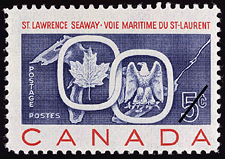
The second and third were the first joint issue of the United States and Canada and were designed to commemorate the opening of the canal itself. These stamps, designed by Arnold Copeland, Ervine Metzl, William H. Buckley and Gerald Trottier, feature the Canadian Maple Leaf and the United States Eagle within interlocking rings superimposed over the Great Lakes. First day of issue was June 26, 1959 at Massena, NY, USA and Ottowa, ON, Canada. The US stamp is Scott #1131 and the Canadian stamp Scott #387:
However, the most famous stamp associated with the St. Lawrence Seaway opening is also one of the world's most famous invert errors, Scott #387a which catalogs for approximately $8,000. Only about 400 of these are known to have been produced:
A complete treatment of these issues with emphasis on the story surrounding this famous error can be found in "The 1959 St. Lawrence Seaway Joint Issue and its Invert" by Charles J.G. Verge published in 2009 on the 50th anniversary of the issue.
(A second USA / Canada joint issue was produced in 1984 for the 25th Anniversary of the opening of the canal (Scott # 2091 & 1015 respectively). However, this issue had similar rather than identical designs - unlike the 1959 issues.)
Labels:
Modern Era Canadian Stamps
Subscribe to:
Posts (Atom)